
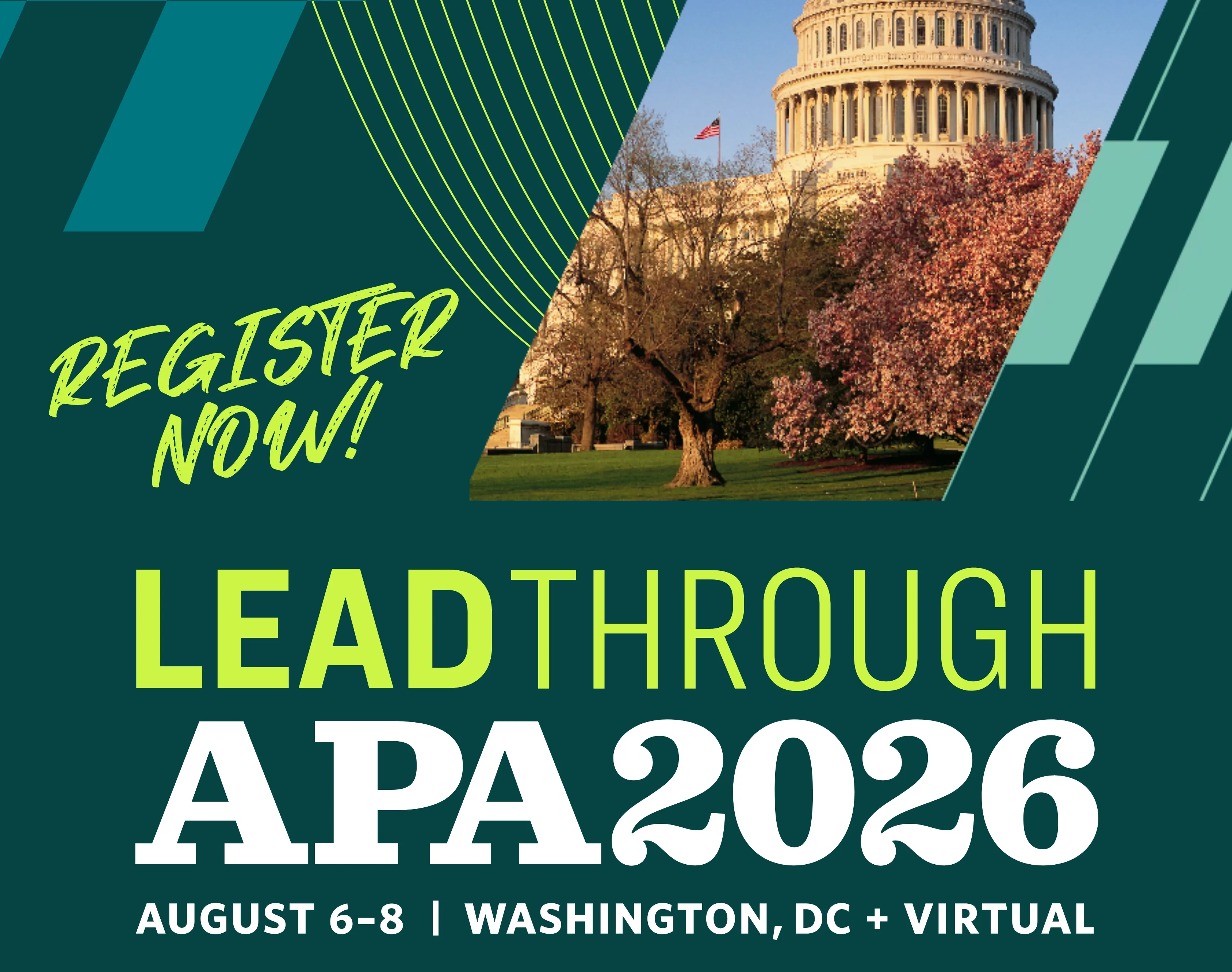
APA 2026 is where practitioners, researchers, educators, and applied psychologists from around the world come together to share transformative ideas and explore the most compelling issues in the discipline. How will you Lead through?
Whatever your professional focus, APA 2026 has the sessions, speakers, and conversations to move your work—and the field—forward.
Registration is now open!
2026 APA Conference Team

Ujjayini Brawley, APA Conference Chair

Robert Hoople, Conference Co-Chair
Division 13 Schedule at APA
Division 13 Informal Room is in Hospitality Suite B, Marriott Level 4
8/6/2026: 12:00 AM – 11:59 PM
8/7/2026: 12:00 AM – 4:00 PM
8/8/2026: 12:00 AM – 11:59 PM
| Time | Session | Presenters | Session/Type | Notes |
|---|---|---|---|---|
| Thursday, August 6 | ||||
| 10:00-11:00 AM | Consulting Ethics for Our Times: A Skills Building Session | Rodney L. Lowman | Skill Building | This skills building session will focus on four ethically complex consulting situations: 1) multiple relationships and multiple roles; 2) organizational pressures to behave unethically; 3) use of AI in consulting; and 4) consultants’ records keeping and retention. Case discussion will focus on how the APA Ethics Code (APA, 2017) applies. |
| 4:00-5:00 PM | Everything You Want to Know About Coaching | Shannon S. Jennings, Liz Sweigart, Ujjayini Brawley | Skill Building | Discover essential skills, strategies, and insights psychologists need to excel in executive and team coaching. This interactive session provides practical steps to grow your coaching practice and actionable knowledge to expand your impact in organizational settings. Get answers to your coaching questions and elevate your professional influence. |
| Friday, August 7 | ||||
| 8:30-9:30 AM | From Individual Leader to Systems Convener: Amplifying Your Impact | Mira Brancu, Emily Keener, Kim Case | Skill Building | Many leaders struggle to create institutional change. This session demonstrates how the unique psychological expertise of psychologist-leaders positions us to convene stakeholders across systems for collective impact. Learn practical frameworks for facilitating cross-organizational coalitions, illustrated through a fourteen-university women faculty leadership initiative using Systems Convening and World Café methodologies. |
| 11:00 AM -12:00 PM | Ignite Talks: The Rhythm of Community | Daniel Lattimore | The Spotlight Stage, Hall D, Solutions Center, End of Aisles 300 & 400 | Ignite talks are short, energetic presentations designed to spark ideas. Each speaker has 5 minutes and presents 20 slides that auto-advance every 15 seconds—so the storytelling is fast, visual, and fun. |
| 11:30 AM–12:30 PM | Spotlight on the 2026 awardees of 100 Psychologists Rising Initiative | Alberta A. Arviso, Gilberte Bastien, Huong Diep, Roy Eidelson, Irene Jacobs, Hareder McDowell, James McLeary, Sherry C. Wang, and Rahul Sharma | Ballroom C, Walter E. Washington Convention Center | 100 Psychologists Rising amplifies psychologists working in non-traditional contexts to inspire the field's evolution beyond conventional boundaries. A TED Talk-style convention presentation highlights innovative applications of psychological science across diverse sectors. |
| 1:00-2:00 PM | From Engagement to Action: Innovative Learning-and-Action Community Models | Skill Building | This symposium explores learning-and-action communities as innovative engagement models for organizations and teams. Presenters will share practical approaches that integrate collaborative learning, psychological safety, and structured action planning to help groups move from shared analysis to sustained, values-aligned action in complex and uncertain environments. | |
| Cultivating Engagement Through Learning-and-Action Communities | Shari Miles-Cohen | |||
| Healing the Hidden Curriculum: A Graduate Student’s Reimagining of Training | Yoscaira Gomez | |||
| Strategic Action Learning Cohorts for Organizational Teams | Lorenzo Moultrie, Jr. | |||
| Connectivism: A Prospective Gen-Z Friendly Engagement Model | Anjali I. Davis | |||
| Fruitive Group Facilitation | Tracy Lamar-Ray | |||
| 2:00-3:30 PM | Breaking Into Consulting: Real-World Insights for Success | Skill Building | Breaking into consulting offers psychologists the opportunity to turn expertise into real-world impact. Consulting psychology applies knowledge from diverse disciplines to enhance the effectiveness of individuals, teams, organizations, and systems. This session provides actionable strategies and practical insights to leverage your academic and professional foundations and build influence and impact. | |
| Why Psychologists Thrive in Entrepreneurship | Ryan C. Warner | |||
| Trends, Tactics, and Strategies for Success | Gregory Pennington | |||
| 4:00 - 5:00 PM | Division 13 Business Meeting | Joanie Connell | Walter E. Washington Convention Center, Street Level Room 149 | Want to know more about Division 13 or missed any of our consulting sessions? Join us for some quick info on the division, meet a few of our leaders and then head over with us after to our lively social hour! |
| 5:30-7:00 PM | Division 13 Social Hour | Your Hosts: Joanie Connell, Ujjiyani Brawley, Bob Hoople | City Tap Penn Quarter in the Tasting Room 901 9th Street NW Washington, DC 20001 | Grab a free drink and tasty appetizers with Division 13! All are welcome... don't miss this event! Who knows you might even win a free membership for a year in the division! Download Calendar Invite |
| Saturday, August 8 | ||||
| 10:30-11:30 AM | Evidence-Based Team Coaching Skills for Building Resilient & Adaptive Teams | Devon Morris, Brandon Raines | Skill Building | Grounded in empirical research, this skill-building session introduces evidence-based team coaching practices for developing resilience, goal commitment, and learning agility. Through interactive activities, participants will learn how psychological mechanisms underlying team coaching support adaptive performance in complex and uncertain organizational contexts. |
| 2:00PM | SCP Museum Walk | Joanie Connell, Ujjiyani Brawley | Meet at Marriott Front entrance at 2pm. We will walk together to go to the National Portrait Gallery and Smithsonian American Art Museum. For more information contact (240)610-4088 | Explore and be inspired during the #SCPinDC Museum Walk! Experience the power of art and connection as we explore some of the local museums near the convention, sparking curiosity, conversation, and new perspectives. More details to follow. |
Full APA 2026 Schedule: